

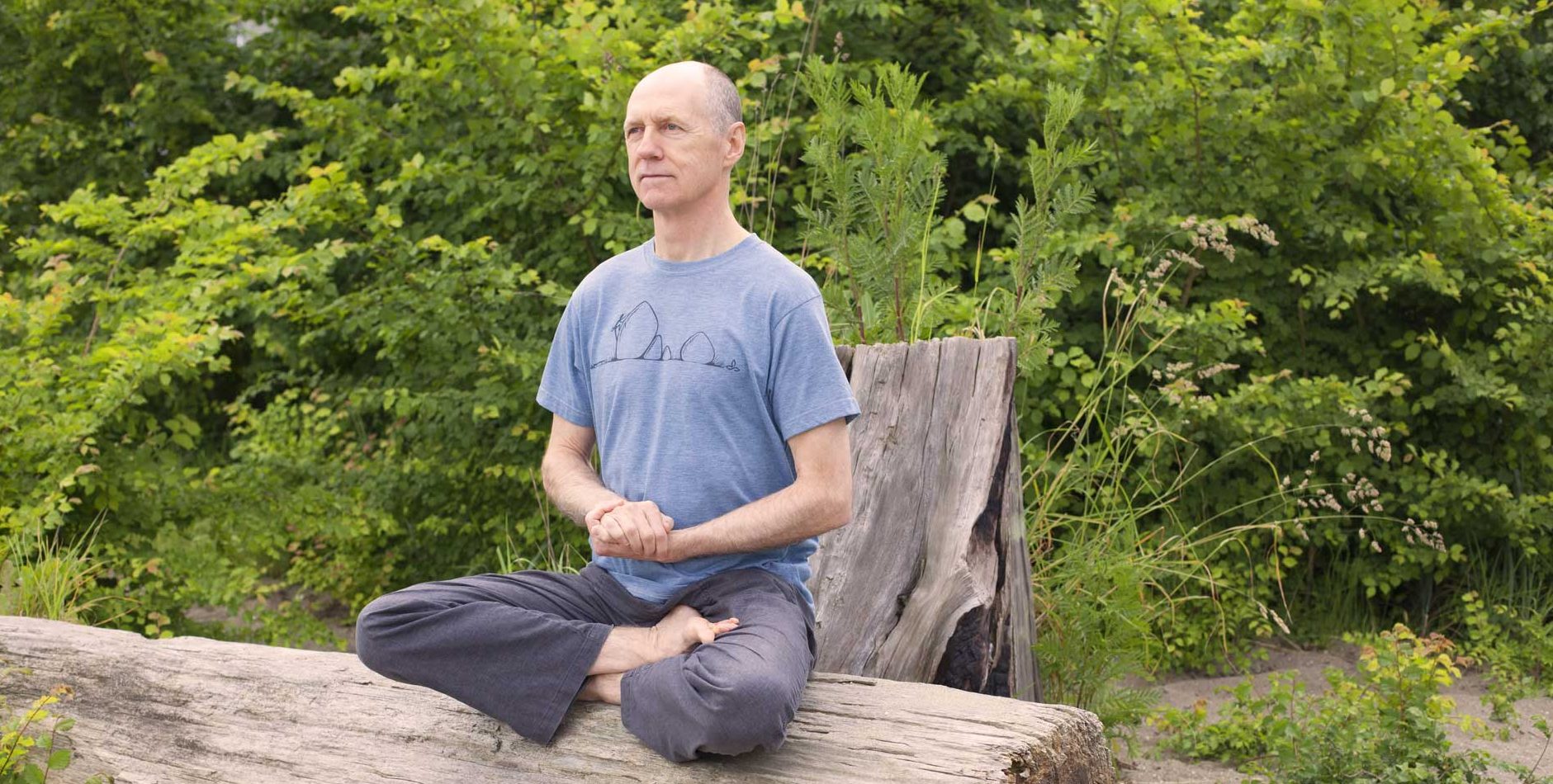
Bernie Clark is an internationally renowned Yin Yoga teacher. In an interview with YOGA AKTUELL he shared his yogic milestones, explained the meridian lines from a western scientific point of view, and spoke about why we should include skeletal variation when teaching yoga.
You can find the German version HERE.
INTERVIEW
YOGA AKTUELL: Bernie, you’ve been practicing meditation and yoga for so many years now. Back in the day you started out with meditation, you then took a deep dive into the Ashtanga world and finally landed in yin yoga. What was your yoga journey like? Could you share some yogic milestones along the way?

Bernie Clark: If we consider yoga as not just the asanas but rather as the 8 limbs Patanjali talks about, I began with the 5th limb, Dhyana – which is meditation. In 1977 I was in the sales group of a big company; it was a very stressful job. I was about 24 years old and had a feeling that I was burning out, so I asked my manager’s manager how he dealt with stress, and he said he meditated every day. He didn’t tell me what type of meditation, so I just went and picked up a book which turned out to be a book on Zen meditation.
For 20 years I was really getting into Zen meditation but always reading from a book. And there’s an old story about reading about Zen: It’s like reading a menu when you’re hungry. You can read a wonderful menu but you’re still hungry and then you drop the menu and go to another restaurant, read their menu but you’re still hungry.
Turns out: I was reading a lot of menus and after 20 years of this I decided that I really needed the teacher. Shakti Mhi, the owner of the Prana Yoga and Zen Center in Vancouver, kept telling me to try the yoga part because the yoga would help me with meditation.
So, in 1997 I started to add asana to my meditation practice. I kind of started with the 5th limb, then went back to the 3rd limb and later added some of the other limbs around there.
Which is interesting because at least these days most yoga practitioners start with the physical practice and then progress on their yoga journey. In the end, you landed in yin yoga. What fascinates you most about yin yoga?
It’s funny how when the time is right, these things just come up. Within a couple of years of asana practice I discovered Power Yoga which was my gateway drug to Ashtanga. I was addicted to Ashtanga doing the Mysore Practice – I had just turned 50 and I loved the practice, but the practice didn’t love me: I was getting hurt, but I kept doing it every morning for five years.
But then I accidentally came across yin yoga through a video by Sarah Powers. And I found that this was really the balance to the very yang activities I’d been doing. After three months of doing yin yoga, I found out that Sarah Powers was coming up to Seattle. I went down to a weekend yoga conference and took a couple of classes with her which motivated me to really get into this more. The next year she and Paul Grilley together were doing a 10-day Yin Yoga teacher training. And I’d say the rest is history. (laughing)
You learned yin yoga from the “founding parents” of yin yoga so to say: Paul Grilley and Sarah Powers. Paul Grilley came up with the idea to give an entire class of long-held poses and then Sarah Powers sprinkled in the mindfulness and meditation aspects. What’s the “founding story” of yin yoga like?
Paul Grilley came across Paulie Zink, a martial arts teacher, and a super flexible dude. Paul admired his range of motion which is why he studied with him for a year to learn from Paulie’s particular approach of asanas: doing postures on the floor for an hour or so. Turns out, this had been done for centuries, nobody actually invented holding poses for a long period of time. But it was Paulie who inspired Paul to investigate this more and find out why this is so effective.
Paul then started to teach these kinds of classes which was unique. Nobody had ever done a class where you would just do 4 postures, each held for 5 to 10 minutes at a time and nothing else. Just an opening meditation, a lot of yin poses, and then shavasana. It was his kind of brilliant insight to make a whole class of this.
At first, he would teach these classes with complete silence. Sarah Powers, an Ashtanga teacher who taught at the same place as Paul, would do Paul’s practice after her own morning practice. Since Paul never said anything, she didn’t really know why it was working.
Life then took them in different directions, they lost contact a little bit. But when they next met up again, Paul had started to describe what was happening physiologically to your tissues when you apply a long-held stress to them. Because he had met Doctor Montoya, a Shinto priest with a double PhD from Tokyo, who educated him on the subtle body, the energy body, the effect on the chi or the prana flowing through the meridians or nadis. The next time, Paul and Sarah got together, and Paul shared this, it really resonated with Sarah.
At the time, Sarah had become a quite renowned yoga teacher traveling the world, and she had started to offer Paul’s teaching and suggested to call it Yin Yoga because of the seated floor postures. That’s how they came up with the name Yin Yoga.
You mentioned that Paul was interested in what was happening physiologically. In your courses and books, you keep bringing up Norma. In yoga, we talk a lot about the ideal alignment of a pose but why would you say there is no such thing as ideal or universal alignment?
Paul was interested in anatomy and the uniqueness in anatomy. When he was in a bone store once and held up two femurs, he realized that people cannot do certain poses because of the different shapes of their bones. This is why he started to bring in the idea of human variation or skeletal variation to his teaching.
Norma and her brother Normman stand for “normal woman” and “normal man.” That usually refers to the average. People have a variety of different characteristics some people are 5 foot tall some people are 6 1/2 feet tall, so the average man is about 5.7, the average woman is about 5.5. But nobody is exactly 5.7, weighs 160 pounds, has blood type 0 and blood pressure 120 / 80. Nobody is average. There is no Norma, no Normman. So, to say that your alignment should be exactly this way because that’s what’s normal, is an illusion. Nobody is like that. We have approximations. There is not one alignment that works for everybody, everybody’s unique. Hence your alignment is going to be unique.
For me personally, you are also one of these “founding parents” of yin yoga. You’re known for bridging the east and the west: you tend to combine Western science with yogic philosophies.
I’ve got a degree in physics and when I heard Paul talking about these anatomical differences and energy, it just really resonated with me: I wanted the practice to not only to help me balance my yang practice, but it made a lot of sense to me. And I can see from a scientific background how this is really affecting the body. I just built on what Sarah and Paul were teaching and took it a little bit more into the western scientific domain.
Yin yoga works on so many different levels. You tend to reference the three types of stillness: When there is stillness of the body, there comes the stillness of the breath, and with that comes the stillness of the mind. But apart from these let’s say physical, emotional and mental benefits, how would you describe the spiritual and energetic benefits of the yin yoga practice?
Two very different topics. On the spiritual side, yoga is often described as a ladder. And I’m talking here about Hatha Yoga. A ladder doesn’t care what wall you put it against, it is simply a tool. You can put it against this wall or that wall, the ladder doesn’t care. Hatha Yoga is the ladder to whatever spiritual intentions you have. If you’re Hindu, Hatha Yoga will help you with your Vedantic understanding. If you’re a Buddhist, Christian, Jew, Islamic, Hatha Yoga can help you progress in whatever spiritual direction you’re going. So, in and of itself it is a tool to still the mind and to be open to whatever.
In the east the idea is that we’re all one. This is great Chandogya Upanishad realization: Tat tvam asi. You are it. That the original divine self split up and became the universe and we’re all sparks of that original self. And our spiritual task in this philosophy is to recognize our identity as divine. You are it, tat tvam asi. The Atman is part of the Brahman. All comes from one.
When you go to the West, that’s heresy. There is God the creator and us as creation. And we are not God, we are not divine, we are divinely created, God created us and our task in the West is to come into relationship with God. You have to figure out how you relate to the divine. That’s a very different practice than in the East where you are the divine.
Your spiritual intention can be quite different but regardless of all that, yoga is the ladder that will help you get there. It’s a way to calm the body, to allow the mind to become at peace. This whole yoga practice is just a tool to help you on that spiritual journey. That’s a different path than the energetic part though. That’s Dr. Motoyama’s teachings.
Moving over to the more energetic side of things: In yin yoga we work the meridian lines according to the traditional Chinese medicine. How would you describe the meridian lines from a western scientific point of view?
If we’re going to talk scientifically, let’s define: What is energy? Now scientists don’t really know what it is, we know what it does. It’s like we don’t know what an atom is, we don’t know what electron is, but we know it has certain properties and acts in certain ways. We use these words as if we understand it all, but we don’t. That’s the base in science: We have some axioms, some basic principles, and from that we build up our whole understanding.
And in our human body, energy does three different things: It moves things, that’s the energy of transportation. It transforms things. It can change raw food into proteins, molecules, bones, and muscles. And then there’s a third form of energy: communication or information. When we look at the meridian lines, these are channels of information. They are water-filled spaces inside the fascia. Now this is all just new realization and the whole fascia research has been blossoming over the last 20 years. And if you look at the textbooks from last century, none of this would be described there, meridians were just ignored, they didn’t really exist – because we weren’t looking in the right places. We were looking for physical channels like blood vessels, we know what those are, we can do a dissection, we’ll find the arteries and veins. Or we were looking for the nerves, would do a dissection and find nerves. But we never found any meridians.
When you do a dissection, most dissectors cut away the fascia so that they can look at the good stuff, the muscles, the bones, the organs, the nerves. But when you cut away the fascia, you’re actually cutting away a very important tissue because it’s within the fascia that we find these water-filled spaces. Our muscles are wrapped by a band of fascia.
I don’t know what it’s like in Germany but in Canada when you buy hot dog wieners, they come with a plastic wrap around them. And sometimes they’re a pack of eight and there’s a plastic wrap around them. That’s like our fascia. All of our muscle fibers have fascia around them, so that they can slide amongst each other. We have water to lubricate. Water is a good conductor of information.
There are water-filled spaces between the muscles, these are conduits where electricity can flow through. These forms of electricity are created through stress. Piezoelectric stress. When you bend a bone, you’re creating electric currents. When you compress your cartilage, you’re creating electric currents. When you flex your muscles, you’re creating electric currents. And these electric currents are flowing through the water.
Now our fascia has conduits of water that are interconnected throughout the whole body. That’s what we believe, the meridians are. They are not imaginary, they’re not like nerves or blood vessels but we do have these passageways throughout the body when you create a certain electric current in one place that communication energy can go to another place in the body. And we think that’s what’s happening when working with chi or prana through the nadis and the meridians…
… which is most felt in a very yum rebound after holding a pose.
Because when you’re holding a pose, sometimes you’re blocking that water and when you let go, it goes aaaahhh. You feel that release, something let go and you feel the floods of energy flowing through you.
Which feels so good. But also, when we think about different body types, you know, there is Stiff Steve who can physiologically increase his range of motion working on his deep tissue doing yin yoga. But what about the Bendy Wendys of this world? Is Yin Yoga also beneficial for them?
As Paul Grilley worked out, there’s really two reasons we get stopped in a pose: One is due to tensile resistance of our tissues, we call it tension. Maybe Stiff Steve’s hamstrings are tight because the nervous system is overactive or there’s lots of different reasons why they might be tight. But the muscles just won’t let go and allow him to bend forward and touch his toes. That’s tension. And it usually shows up on the backside of a movement: If I’m folding forward, I feel it on my spine and the back of my legs, that is tensile resistance preventing me from getting further.
Well, Bendy Wendy or Flexy Flora as I call her, she can touch her toes, no problem. You put her on the floor in Pashimottanasana or Caterpillar, she brings her chest to her thighs, doesn’t feel anything. She is stopped by compression which is the other of the two reasons that Paul defined. Compression is when the body hits the body. Two bones are hitting, that’s compression. Once you hit compression, you can’t go any further in that direction, you’ve reached your ultimate limit.
Now Stiff Steve doesn’t have compression, he is stopped by tension and overtime he can stretch that out. But Flexy Flora is stopped by compression, and no matter how many years she works on it, she’s not going to change that.
Yin Yoga is good for Steve to get more and more open, but eventually he will also hit his limit and maybe because of the shape of his bones, he will never bring his chest to his thighs. And that’s okay, that’s his uniqueness. But it is also good for Flexy Flora or Bendy Wendy because bones need stress. You need to stress the bone, so that the bones can grow thicker and stronger. It’s not bad for someone to hang out at their end range of motion. What’s dangerous is to try to go past that. If you try to go past where compression stops you, that’s when you can risk damaging the joint.
Go to where your body will go, that’s cool. Flora, Steve, they all go to where they can go, just don’t try to go past that.
And no matter what our physical shape look like when we go into a pose, as you tend to say…
It’s irrelevant! (laughing)
… and as long as you’re feeling it, you’re doing it. And that’s the beauty of yin yoga. What would you say, what has been the most beautiful gift yin yoga has given you?
The quietening. I’m a type A personality, that’s why I loved Ashtanga so much. I always wanted to do more, do more, do more. And the Yin aspect of life is accepting what you have. I like to think of new resolutions now not as what I’m going to change about myself for the next year, but what am I going to accept about myself this year and not try to change. Yin is allowing, to go to where you stop and that’s it. Maybe the body will open up and go further but that’s not the point.
The point is just to be where you’re at and that’s a beautiful balance to our western “do more, do more, do more.” Yin Yoga turns it around: „Just be. Be with what is.“
But you need both, you can’t always be yin, but you can’t always be yang either.
So true, thank you very much, Bernie.
|
More about Bernie Clark on his website: www.yinyoga.com |
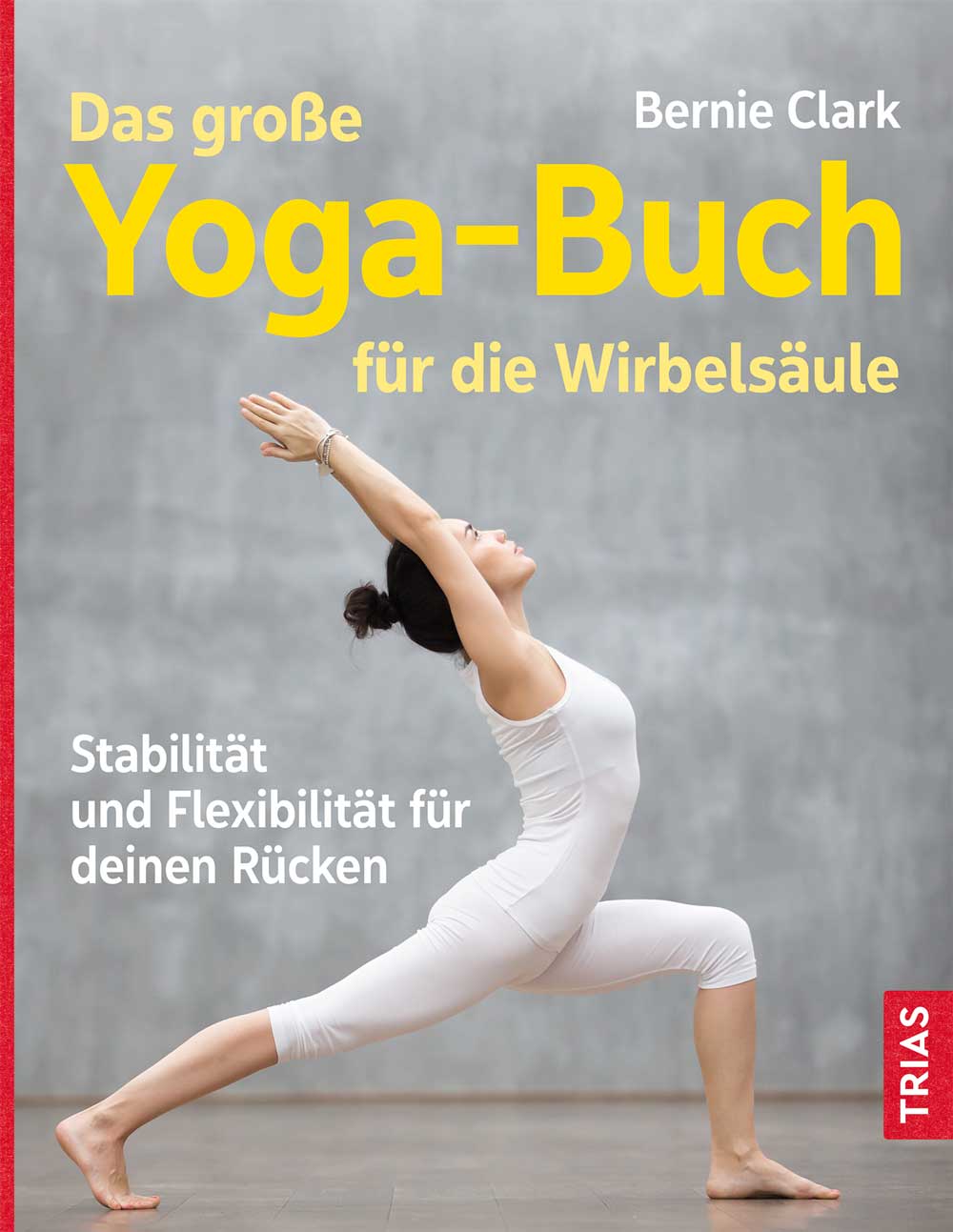
His latest book is now also available in German: Das große Yoga-Buch für die Wirbelsäule. Stabilität und Flexibilität für deinen Rücken. Trias Verlag, 2023.







Bernie Clark ist ein echt toller Lehrer. Er unterrichtet ja z.B. den Dragon Dance, eine Mischung aus Yoga, Tai Chi und Chi Gong und legt dabei den Focus auf das Flexibler werden im Geiste. Es gibt auch ein umfangreiches PDF von ihm, um seinen Dragon Dance selbst zu unterrichten! Liebe Grüße, Jan